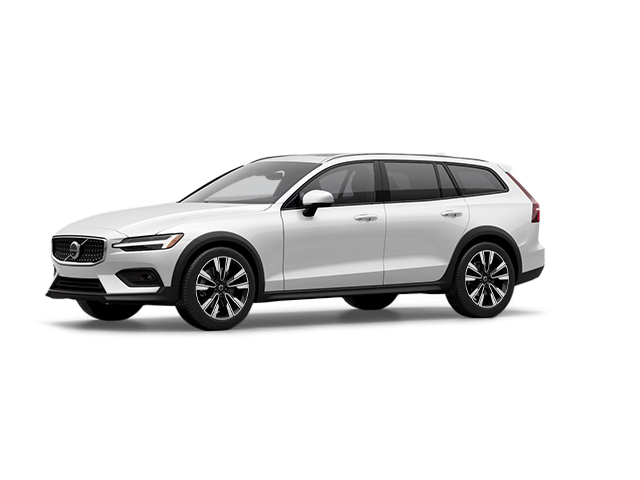
Photo for illustrative purposes only.
Find out moreVolvo Cars Toronto

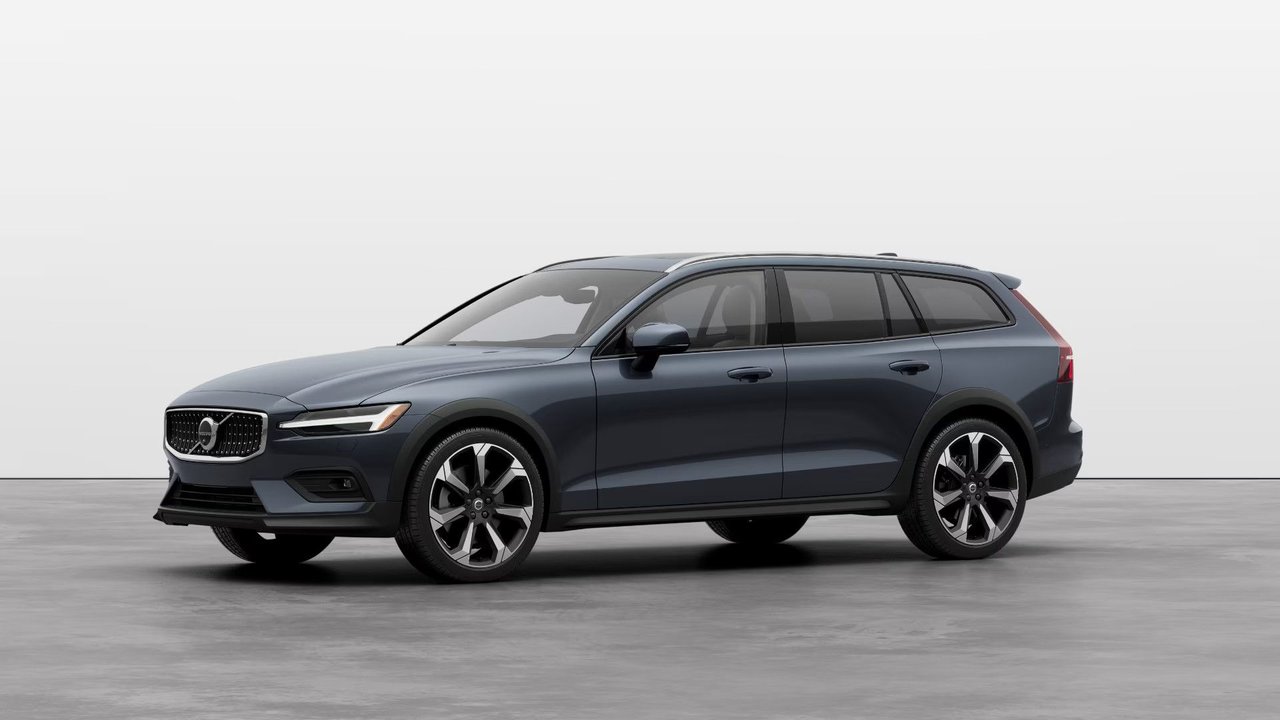
Two Volvo wagons with Cross Country credentials, similar powertrains, and distinct personalities. The V60 Cross Country and the V90 Cross Country share a platform lineage and a philosophy — AWD long-wheelbase touring wagons with more ground clearance than a standard estate — but they answer different questions. One is sized for efficiency and urban versatility. The other is built for space, long-distance comfort, and carrying capacity. Understanding the differences between them is straightforward once the specs are side by side.
This guide compares the 2026 V60 Cross Country and V90 Cross Country across the dimensions that matter most for wagon buyers: dimensions, powertrain, cargo, features, and what each one is best suited for.
|
Specification |
V60 Cross Country B5 AWD |
V90 Cross Country B6 AWD |
|---|---|---|
|
Engine |
2.0 L 4-cyl mild hybrid |
2.0 L 4-cyl mild hybrid |
|
Output |
247 hp / 258 lb-ft |
295 hp / 310 lb-ft |
|
0–100 km/h |
6.9 sec |
6.4 sec |
|
Fuel economy (comb.) |
8.9 L/100 km |
9.3 L/100 km |
|
Length |
4,787 mm |
4,959 mm |
|
Wheelbase |
2,875 mm |
2,941 mm |
|
Ground clearance |
197 mm |
195 mm |
|
Cargo (seats up) |
648 L |
551 L |
|
Cargo (seats folded) |
1,431 L |
1,517 L |
|
Towing (braked) |
1,984 lbs (900 kg) |
1,984 lbs (900 kg) |
|
Seating |
5 |
5 |
|
Trim levels |
Ultra |
Ultra |
Both vehicles use a 2.0 L inline 4-cylinder mild hybrid with an 8-speed Geartronic automatic and permanent AWD. The 48V ISG in each model recovers braking energy and feeds it back during acceleration, reducing fuel demand without requiring a plug.
The V60 Cross Country uses the B5 variant: 247 hp and 258 lb-ft of torque, reaching 100 km/h in 6.9 seconds. NRCan 2026 fuel economy: 10.1/7.6/8.9 L/100 km (City/Hwy/Comb).
The V90 Cross Country uses the B6: a supercharged and turbocharged variant producing 295 hp and 310 lb-ft of torque, reaching 100 km/h in 6.4 seconds. NRCan 2026 fuel economy: 10.4/8.0/9.3 L/100 km (City/Hwy/Comb).
The V90 is 48 hp stronger and 0.5 seconds quicker to 100 km/h. The V60 is more efficient: 8.9 L/100 km combined vs. 9.3 L/100 km — a difference of 0.4 L/100 km. At 20,000 km per year, that gap translates to roughly 80 L of fuel annually, or approximately $115–$120 at current pricing. For most buyers, the powertrain choice comes down to whether the extra performance of the B6 is worth that running cost difference.
The V60 Cross Country is 172 mm shorter and rides on a wheelbase 66 mm tighter than the V90. That shorter footprint is tangible in urban driving — parking, lane changes, and navigating tighter city streets are all marginally easier in the V60. Ground clearance is nearly identical: 197 mm on the V60 vs. 195 mm on the V90. Both handle packed snow, unpaved gravel, and variable shoulder-season road conditions confidently.
The V90's longer wheelbase delivers more rear-seat leg room: 911 mm on the V90 against 895 mm on the V60. For regular adult rear passengers, that 16 mm difference is modest but real over longer journeys.

Cargo volume produces the most counterintuitive comparison between these two models.
With the rear seats up, the V60 Cross Country actually carries more: 648 L vs. 551 L. The V60's cargo area geometry — shorter overall length but a more efficient cargo bay design — gives it a practical edge for everyday loading.
With both rear seats fully folded, the V90 takes the lead: 1,517 L vs. 1,431 L. That 86 L difference reflects the V90's longer body and greater internal volume when the passenger compartment is converted to full cargo mode. For buyers who regularly transport large, flat items — furniture, sporting equipment, building materials — the V90's folded cargo capacity is the relevant figure.
Load floor height to ground is similar on both: approximately 679–680 mm. Both vehicles use the same Cross Country loading approach, with a low, flat cargo floor and a wide rear opening.
Both the V60 Cross Country and V90 Cross Country are offered in a single trim in Canada for 2026: the Ultra. This means there is no entry-level or mid-range configuration to navigate — both wagons arrive fully equipped from the start.
V60 Cross Country Ultra includes Pilot Assist, head-up display, 360° camera, park assist for front/rear/sides, Harman Kardon Premium Sound, air-ventilated subwoofer, four-zone climate, air purifier with remote cabin pre-cleaning, ventilated nappa leather upholstery, interior illumination at high level, heated front and rear seats, front seat ventilation, and a panoramic roof. Google Assistant with Google Maps and Google Play Store, Apple CarPlay, Android Auto, and the Volvo Cars app are all standard.
V90 Cross Country Ultra arrives with an equivalent feature set: Pilot Assist, head-up display, 360° camera, park assist for front/rear/sides, Harman Kardon Premium Sound, air-ventilated subwoofer, four-zone climate, air purifier with remote cabin pre-cleaning, ventilated nappa leather upholstery, interior illumination at high level, heated front and rear seats, front seat ventilation, panoramic roof, and rear door sun curtains — a feature not present on the V60. Post impact braking is also standard on the V90 Ultra.
Where the two wagons differ at the Ultra level is primarily in exterior identity (Driftwood decor on the V60; Grey Ash decor on the V90), headlining (Blond on both), and the V90's illuminated sill moulding. Both include the Crystal gear shift by Orrefors, keyless entry with hands-free power tailgate, and all-season tyres as standard.
The V60 Cross Country suits buyers who want a well-equipped AWD touring wagon with efficient fuel economy, easy urban manoeuvrability, and a larger day-to-day cargo area. Both wagons arrive in a single fully loaded Ultra configuration, so the decision is not about trim level — it comes down to size, powertrain, and how you use the cargo area.
The V90 Cross Country suits buyers who spend significant time on highways, regularly carry adult passengers in the rear seat, or need the maximum cargo volume when the seats are folded. The B6 engine's additional 48 hp is relevant for those who tow or load the vehicle regularly. The V90's longer body delivers a more settled feel at higher highway speeds — a noticeable difference on long-distance drives.
Towing capacity is identical between both: 1,984 lbs (900 kg) braked, so this factor does not differentiate the two.
If you are genuinely considering both, schedule time to sit in each one back to back at Volvo Cars Toronto — the cargo geometry and rear seat space feel different in person than the numbers suggest, and the B5 vs. B6 powertrain difference is clearest on a test route with highway content. The team in Toronto can set that up.
Photo for illustrative purposes only.
Find out more
Adapter-Free Supercharger Access: What the 2027 Volvo EX60’s NACS Port Opens Up
Charging an EV shouldn’t feel like carrying a bag of adapters. If you’re weighing the 2027 Volvo EX60, one detail matters more than it might seem:...
Read more
How Far the 2026 Volvo XC60 T8 Drives on Electric Before Switching to Gas
Most commutes are shorter than drivers think, and that gap between how far you actually drive and how far you assume you drive is exactly where a...
Read more
How Standard AWD Helps the 2026 Volvo XC40 on Wet Fall Roads
Fall driving in Ontario means wet pavement, wet leaves, and mornings where the road grip you had yesterday just isn’t there today. The 2026 Volvo...
Read morePowered and developed by
